In a dramatic weekend development that has gripped the globe, President Donald Trump confirmed the successful military extraction of a missing American airman from hostile territory. The high-risk Trump Iran pilot rescue operation concludes a frantic two-day search following the downing of an F-15E Strike Eagle. The successful mission comes at a powder-keg moment for global markets and international security, arriving just hours before the White House's Strait of Hormuz 48 hour deadline is set to expire on Monday.
"We Got Him!": The Truth Social Announcement
Early Sunday morning, April 5, 2026, the President broke the news of the successful extraction to the American public. Taking to his preferred platform, the Donald Trump Truth Social Iran update featured his signature capitalization and enthusiastic tone.
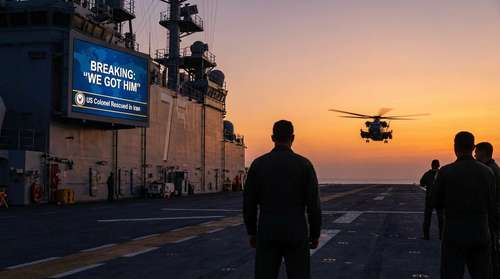
"WE GOT HIM!" the President posted just after midnight. "My fellow Americans, over the past several hours, the United States Military pulled off one of the most daring Search and Rescue Operations in U.S. History, for one of our incredible Crew Member Officers, who also happens to be a highly respected Colonel, and who I am thrilled to let you know is now SAFE and SOUND!"
The Commander in Chief added that the airman sustained minor injuries during the ordeal but assured the public he "will be just fine". Notably, Trump emphasized that the U.S. achieved this feat without a single American service member being killed or wounded, framing the success as a testament to the Iran air dominance US military forces have maintained during the five-week conflict.
Inside the Harrowing Iranian Mountain Extraction
The crisis began on Friday when an American F-15E Strike Eagle was struck by Iranian air defenses, forcing its two-person crew to eject over treacherous, mountainous terrain. While the pilot was quickly recovered within hours of the crash, the fate of the weapons system officer—a highly trained U.S. Colonel—remained uncertain.
For roughly 48 hours, the missing US Colonel rescued in Iran utilized advanced Survival, Evasion, Resistance, and Escape (SERE) training to avoid capture. As converging Islamic Revolutionary Guard Corps (IRGC) and Basij militia units aggressively hunted him, the airman moved cautiously through the unforgiving landscape, eventually activating an emergency beacon to signal his location to American rescue teams.
A Fierce Firefight Behind Enemy Lines
The recovery was anything but simple. As elite U.S. commandos converged on the Colonel's location late Saturday night, heavily armed Iranian forces closed in. A fierce firefight erupted. Backed by relentless close air support that pounded Iranian convoys, the extraction team successfully secured the airman.
According to military sources, the massive operation required dozens of aircraft, including C-130s and rescue helicopters flying dangerously low and slow to avoid radar detection. While two of the rescue helicopters reportedly took ground fire, the extraction force ultimately breached enemy lines and transported the Colonel to a military hospital in Kuwait.
The Looming Middle East Energy Corridor Crisis
While the successful rescue serves as a massive morale boost for American forces, the tactical victory is overshadowed by a rapidly escalating strategic nightmare. The Middle East energy corridor crisis is reaching a boiling point as the world waits for Tehran's next move.
The White House previously issued a stern ultimatum, demanding that Iranian forces cease their blockades and reopen the Strait of Hormuz to international shipping. If the mandate is ignored when the deadline expires on Monday, April 6, Trump has explicitly warned that the Iranian regime will face "hell".
What to Expect Next in the Conflict
For those tracking the latest US Iran war updates 2026, it is clear that the window for diplomatic de-escalation is closing rapidly. The downing of the F-15E—the first U.S. aircraft lost over Iranian soil in this conflict—and the subsequent intense firefight prove that Tehran's air defenses and ground militias remain highly active despite weeks of targeted American strikes.
Adding to the tension, officials confirmed that an A-10 Thunderbolt II attack plane was also struck by incoming fire on Friday, though its pilot successfully navigated to Kuwaiti airspace before ejecting safely. Now that all downed crew members are securely out of hostile territory, military analysts anticipate that the United States will operate with fewer tactical restraints. Without the risk of an American prisoner of war being used as leverage, the Pentagon is uniquely positioned to enforce the Monday deadline with overwhelming force if necessary.
As Sunday progresses, all eyes remain fixed on the Persian Gulf. The rescue is a defining moment of this conflict, but the true test of international resolve will begin the moment the 48-hour clock strikes zero.