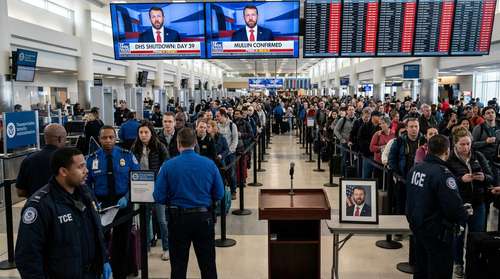
The political and logistical crisis gripping the nation reached a boiling point this week as the DHS shutdown 2026 entered its 39th day. In a pivotal move, the U.S. Senate officially confirmed former Oklahoma Senator Markwayne Mullin as the new Secretary of the Department of Homeland Security. The 54-45 party-line vote arrives at a critical juncture, with President Donald Trump escalating his response to the shutdown by deploying armed Immigration and Customs Enforcement (ICE) personnel to major transit hubs across the country. As lawmakers remain gridlocked over immigration reform, American travelers are bearing the brunt of the fallout.
Markwayne Mullin Confirmation Shakes Up Homeland Security
The Markwayne Mullin confirmation late Monday evening officially instills new leadership at a deeply fractured agency. Mullin succeeds former Secretary Kristi Noem, who was ousted earlier this month following intense bipartisan scrutiny over her handling of federal immigration crackdowns and deadly shootings by federal agents in Minneapolis.
During his confirmation hearings, Mullin struck a delicate balance. While remaining a staunch ally of the administration, he promised to bring accountability to the department. To secure necessary bipartisan support—notably from Democratic Senators John Fetterman and Martin Heinrich—Mullin indicated that under his watch, federal agents would be required to secure judicial warrants before entering private homes and businesses. Despite opposition from Kentucky Senator Rand Paul, the only Republican to vote against him, Mullin now faces the monumental task of steering an agency starved of its baseline funding.
ICE Agents at Airports: Addressing the TSA Staffing Shortage
To alleviate the massive bottlenecks crippling domestic and international flights, the administration has authorized a highly controversial deployment of ICE agents at airports. Starting Monday, federal immigration officers were stationed at 14 major U.S. airports, including John F. Kennedy International, Hartsfield-Jackson Atlanta, and Newark Liberty.
White House border czar Tom Homan confirmed the strategy aims to mitigate a severe TSA staffing shortage. For over a month, approximately 50,000 Transportation Security Administration employees have been working without pay. Driven to a financial breaking point, daily callout rates have surged past 50% in some cities, and hundreds of officers have formally resigned. While ICE agents are not trained to operate X-ray machines or conduct standard security screenings, they are being utilized for crowd control and exit monitoring, freeing up the remaining TSA workforce to process passengers.
Why Are ICE Agents Paid While TSA Works for Free?
The disparity between the two agencies has sparked outrage among federal labor unions. The core of the DHS shutdown 2026 revolves around lapsed funding for standard DHS operations. However, ICE and Customs and Border Protection (CBP) operations are insulated from the freeze due to the administration's previously passed One Big Beautiful Bill Act, which pre-funded federal immigration enforcement. Consequently, deployed ICE personnel are receiving their standard paychecks, while the TSA agents they are assisting continue to work without financial compensation.
Government Shutdown Travel Impact and US Airport Delays Today
The government shutdown travel impact has been devastating for the aviation industry and the traveling public. US airport delays today stretch for hours, with security lines frequently spilling out of terminal buildings and into parking garages. In hubs like Houston Hobby and New Orleans' Louis Armstrong International, passengers are reporting wait times exceeding three hours, resulting in thousands of missed flights.
Critics, including House Democratic Leader Hakeem Jeffries, have fiercely condemned the presence of immigration enforcement at transit centers, arguing that utilizing untrained agents for aviation security makes travel more chaotic. Furthermore, civil rights advocates are raising constitutional alarms, warning that the deployment could lead to unwarranted interrogations or localized enforcement actions against travelers. Homan has maintained that the primary directive is crowd management, but noted that agents are authorized to act if they witness criminal activity.
The Future of Trump Homeland Security Policy
The ongoing fiscal standoff illustrates the aggressive nature of the current Trump Homeland Security policy. The shutdown was triggered in mid-February when congressional Democrats refused to pass long-term DHS funding without strict mandates—such as body cameras and the abolition of administrative warrants—following the deaths of two U.S. citizens during ICE operations earlier this year. The White House has firmly rejected these demands, asserting they would fundamentally handicap the administration's broader deportation and security agenda.
With Markwayne Mullin now officially at the helm, all eyes are on the Senate negotiating table. Whether the new Secretary can broker a compromise to end the DHS shutdown 2026, restore TSA paychecks, and successfully execute the administration's security objectives remains to be seen. For now, Americans planning to fly should prepare for continued disruptions and an unprecedented federal law enforcement presence at their local departure gates.