The financial world is reeling from a severe stock market crash today, as a convergence of geopolitical turmoil and sticky inflation sent equities into a tailspin. Following the highly anticipated Fed rate decision March 2026, the Dow Jones Industrial Average plummeted 768 points, marking its lowest close of the year. Investors are currently grappling with the reality of an escalating Middle Eastern energy crisis, which has propelled Brent crude prices toward a staggering $114 per barrel and forced the central bank to maintain its aggressive posture.
The Federal Reserve's Hawkish Stance on Interest Rates
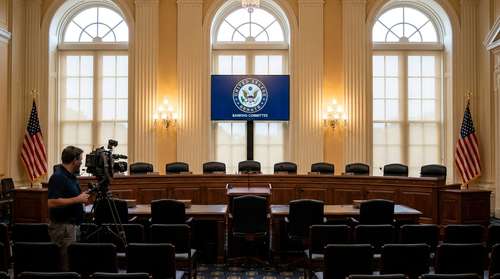
On Wednesday, the Federal Reserve voted 11-1 to keep its benchmark interest rate steady at 3.5% to 3.75%. While market participants had largely priced in the pause, the accompanying rhetoric from Fed Chair Jerome Powell caught Wall Street off guard. Powell delivered what analysts are calling his most hawkish communication of the current cycle, citing hotter-than-expected producer price index (PPI) data and the massive inflationary overhang created by the prolonged Iran war.
The central bank's updated dot plot projections cast a shadow over hopes for near-term relief. While policymakers signaled that one rate cut might still be on the table for later in 2026, the Federal Reserve hawkish stance made it abundantly clear that combating inflation remains the absolute priority. With the US economy struggling to make meaningful progress toward the 2% inflation target, the prolonged higher-for-longer environment is putting immense pressure on corporate earnings, commercial real estate, and consumer spending.
Iran War Oil Price Impact: Brent Crude Surges
The primary catalyst forcing the Fed's hand is the catastrophic disruption to global energy markets. The Iran war oil price impact has been swift and brutal, with near-total halts in traffic through the Strait of Hormuz—a critical chokepoint for roughly one-fifth of the world's seaborne oil trade. In response to recent military escalations, including targeted strikes on major Middle Eastern energy infrastructure, crude supplies have tightened at a pace that has shocked international markets.
Major financial institutions are aggressively revising their energy models. Bank of America and Goldman Sachs have both issued dire warnings regarding the Brent crude price forecast. While baseline projections suggest Brent could average around $85 if disruptions ease by the second quarter, analysts warn that a prolonged blockade extending past 60 days could send prices surging well past $100 to $114 per barrel, with some worst-case scenarios eyeing $130. Nearly 200 million barrels of crude have already been removed from the global supply chain, effectively erasing last year's inventory builds in a matter of weeks. This relentless energy shock threatens to erase months of disinflationary progress, creating a nightmare scenario for import-dependent nations.
Supply Chain Paralysis and Natural Gas Shortages
Beyond crude oil, the conflict has completely disrupted the natural gas market. With major liquefied natural gas (LNG) production facilities declaring force majeure after sustained drone attacks, Europe and Asia are scrambling for alternative energy sources. This structural supply disruption has transformed a previously balanced market into one characterized by extreme volatility, driving European natural gas futures significantly above their 12-month averages.
Wall Street Bleeds: Dow Jones 2026 Lows
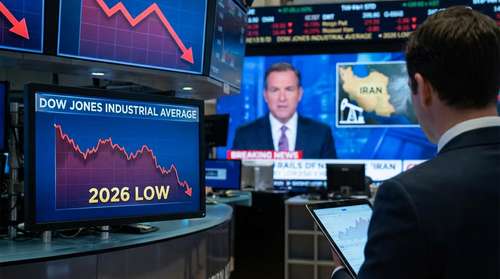
The lethal combination of surging energy costs and deferred interest rate cuts triggered panic selling across all major exchanges. The Dow Jones Industrial Average collapsed by 1.63% to close at 46,225.15, officially breaching its 200-day moving average and setting new Dow Jones 2026 lows. This technical breakdown is viewed by institutional chart analysts as a highly bearish signal that could invite further algorithmic selling in the days ahead.
The carnage was not limited to blue-chip stocks. The S&P 500 tumbled 1.36%, while the tech-heavy Nasdaq Composite shed 1.46%. The broader market sell-off highlights a rapid repricing of risk assets as investors digest the reality that the much-anticipated 2026 rate-cut cycle has been derailed. Wall Street's fear gauge, the Cboe Volatility Index (VIX), snapped its recent losing streak, surging as portfolio managers rushed to hedge against further downside exposure.
Navigating Global Economic Crisis News
As retail and institutional investors alike absorb the latest global economic crisis news, the strategy moving forward requires extreme caution. The dual threats of a slowing domestic economy and resurgent commodity-driven inflation are raising the specter of stagflation. This macroeconomic environment has historically created a hostile landscape for traditional equities.
Financial advisors are urging clients to reassess their exposure to vulnerable sectors, particularly those sensitive to rising input costs and prolonged high borrowing rates. While the immediate outlook appears grim, market dislocations of this magnitude often present strategic opportunities for disciplined investors. Energy sector equities and physical commodities continue to attract defensive capital. However, until the geopolitical temperature in the Middle East cools and the Federal Reserve sees definitive proof of retreating inflation, violent market swings are guaranteed to remain the defining feature of the 2026 financial landscape.