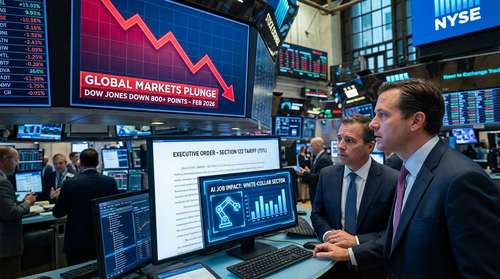
NEW YORK – Global financial markets are in freefall this Tuesday, February 24, 2026, as a perfect storm of trade volatility and technological anxiety slams Wall Street. The Dow Jones Industrial Average plummeted over 800 points in early trading, marking its worst single-day decline since late 2024. The sharp downturn is driven by the immediate implementation of President Trump’s controversial 15% global tariff surcharge and compounded by a viral research report predicting an accelerated displacement of white-collar jobs by artificial intelligence.
Trump Implements 15% Global Tariff Under 1974 Trade Act
The primary catalyst for the market's nosedive is the sudden activation of a 15% blanket tariff on virtually all U.S. imports. Following a stunning Supreme Court ruling last week in Learning Resources, Inc. v. Trump that invalidated previous levies imposed under the International Emergency Economic Powers Act (IEEPA), the administration has pivoted to a rarely used statute to maintain its protectionist agenda.
Effective as of 12:01 a.m. today, the President has invoked Section 122 of the Trade Act of 1974. This provision grants the executive branch the authority to impose temporary import surcharges of up to 15% for 150 days to address "fundamental international payments problems." The administration cites a record-breaking balance-of-payments deficit as the legal justification for the move.
"This is a shock to the system that few priced in," said Elena Rodriguez, Chief Global Strategist at Horizon Capital. "Investors assumed the Supreme Court ruling would pause the trade war. Instead, the White House has doubled down with a blunt instrument that hits every trading partner—from China to the European Union—without exception."
Viral AI Report Sparks Tech Sector Retreat
Compounding the trade-induced panic is a massive retreat in the technology sector, triggered by a viral research report circulated late Monday by a leading macroeconomic think tank. The report, titled The White-Collar Cliff, corroborates recent warnings from industry leaders like Anthropic CEO Dario Amodei, projecting that generative AI could displace up to 50% of entry-level corporate roles within the next 24 months.
The study highlights a "decoupling" of corporate profits from headcount, warning that major S&P 500 companies are quietly preparing to slash administrative and analytical workforces in favor of autonomous AI agents. This narrative has spooked investors, leading to a steep sell-off in major tech stocks. Shares in enterprise software and consulting firms—sectors most exposed to AI automation—have dropped between 4% and 7% in pre-market trading.
"The market is waking up to the deflationary reality of AI," noted tech analyst Marcus Thorne. "It’s not just about efficiency anymore; it’s about the potential collapse of consumer purchasing power if white-collar employment contracts as fast as this report suggests."
Global Trade War Fears Reignite
The combination of the Trump 15% global tariff 2026 implementation and the tech sell-off has created a toxic environment for risk assets. International indices followed Wall Street lower, with the FTSE 100 and DAX both shedding over 2% as European exporters brace for the new U.S. surcharge.
Under Section 122, the surcharge is legally capped at 150 days unless extended by Congress. However, market analysts fear that the administration will use this window to negotiate aggressive new bilateral deals, effectively keeping global trade in a state of flux for the foreseeable future. Retaliatory measures from major trading partners are expected within days, raising the specter of a renewed global trade war in 2026 that could drag the global economy into recession.
What Investors Should Watch Next
As volatility spikes, the "fear gauge" or VIX has surged to levels not seen in over a year. Investors are fleeing to safe havens, driving gold prices to new highs and pushing Treasury yields lower. The immediate focus will now shift to Congress, which has the power to override the Section 122 action, though political gridlock makes immediate intervention unlikely.
For now, the dual headwinds of a protectionist trade policy and an AI-driven labor market disruption have left the bulls with nowhere to hide. As the closing bell approaches, all eyes remain on the Dow to see if the 800-point loss will hold—or deepen.