
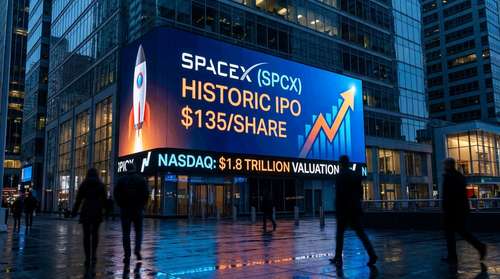
The wait is finally over. Tonight, June 11, 2026, Space Exploration Technologies Corp. officially prices its highly anticipated shares, setting the stage for the most monumental market debut ever recorded. The SpaceX IPO is reportedly more than four times oversubscribed as institutional frenzy grips Wall Street ahead of tomorrow's opening bell. This milestone marks the culmination of a 24-year journey from a scrappy aerospace startup to an interplanetary and digital juggernaut. Tomorrow's SpaceX Nasdaq listing will officially christen the rocket, satellite, and artificial intelligence powerhouse as a publicly traded entity, permanently altering the landscape of the technology sector.
Shattering Records: The Largest IPO in History
Seeking to raise a staggering $75 billion through the issuance of 555.6 million shares, this offering completely eclipses previous global financial benchmarks. When Saudi Aramco went public in December 2019, it secured $25.6 billion—a record the financial world assumed would stand for decades. The Chinese e-commerce giant Alibaba similarly held the technology sector crown with its $21.8 billion float in 2014. SpaceX is not just breaking those historical records; it is obliterating them.
With shares fixed at $135 each, the impending debut implies a towering SpaceX valuation 2026 of approximately $1.77 trillion to $1.8 trillion. To put that astronomical figure into perspective, a $1.8 trillion market capitalization is roughly equivalent to the entire annual gross domestic product of Australia. Right out of the gate, the company will immediately rank among the ten most valuable publicly traded corporations on Earth, trailing only the likes of Apple, Nvidia, and Microsoft.
Institutional demand has pushed the offering past four times oversubscribed status. Heavyweight asset managers and sovereign wealth funds have clamored for a piece of the pie, practically guaranteeing that the opening SPCX stock price will experience extreme volatility and massive trading volumes as soon as the stock begins crossing the tape on Friday morning.
Elon Musk SpaceX: The Trifecta of Rockets, Starlink, and AI
What exactly are investors buying into at a near-$1.8 trillion price tag? The modern iteration of Elon Musk SpaceX is a complex, three-headed titan: commercial spaceflight, global telecommunications, and cutting-edge artificial intelligence. While the company's traditional launch business remains globally unparalleled—controlling approximately 80% of all US rocket flights and 90% of the global commercial launch market—it is the digital infrastructure that serves as the immediate financial engine.
Recent SEC S-1 filings revealed the immense profitability of the Starlink division. The satellite broadband service accounted for an impressive $11.4 billion of the firm's $18.7 billion total revenue in 2025. Driven by a subscriber base that has rapidly expanded past 12 million users across 164 countries, Starlink generated the bulk of the company's adjusted EBITDA.
However, the real wildcard inflating the massive SpaceX valuation 2026 is the recent, aggressive expansion into artificial intelligence. Following a massive internal reorganization that integrated xAI into the broader corporate structure, the company has positioned itself as a dual-threat tech conglomerate. Fusing AI infrastructure with a proprietary low-earth orbit satellite constellation gives the firm a distinct edge in global data processing, even if it comes at a steep short-term cost. Filings show the company posted a $4.28 billion net loss in the first quarter of 2026, driven largely by aggressive AI capital expenditures and infrastructure build-outs.
Evaluating the SPCX Stock Price Potential
Launching at nearly 100 times its 2025 revenue requires flawless ongoing execution. Bullish analysts point to the company's unassailable launch monopoly and the explosive, high-margin growth of space-based broadband. Skeptics, conversely, warn that integrating a heavily unprofitable artificial intelligence division into a capital-intensive aerospace operation carries stratospheric risk. Wall Street underwriting banks have heavily marketed the long-term cash-flow potential, but early traders must be willing to stomach the near-term cash burn.
How to Buy SpaceX Shares Following the SpaceX Nasdaq Listing
For everyday retail investors wondering how to buy SpaceX shares, the mechanics of this specific offering are unusually accessible. In a highly irregular move for a mega-cap technology float, the 21-bank underwriting syndicate, led by Goldman Sachs, has reportedly earmarked up to 30% of the available float specifically for retail investors. This is three times the standard allocation for an offering of this magnitude.
Once the final $135 pricing is legally confirmed after tonight's close, early allocations will begin appearing in participating brokerage accounts. For the millions of investors who did not secure pre-IPO access through their brokers, the stock will become available on the open market tomorrow morning. Participating in the SpaceX Nasdaq listing requires patience on day one.
When the opening bell rings, the stock will not trade immediately. It will go through a standard price discovery phase, known as the opening cross, where buy and sell orders are matched to determine the first public trade. Ensure your brokerage account is fully funded, consider using limit orders to protect yourself against wild intraday swings, and be prepared for wide bid-ask spreads during the initial hours of trading. Whether you are a long-term believer in interplanetary colonization or a momentum trader playing the AI hype, tomorrow's session will undoubtedly cement itself as the largest IPO in history.