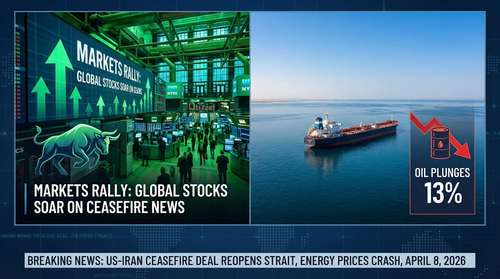
International equity markets witnessed a massive surge on Wednesday after Washington and Tehran announced a sudden two-week pause in military hostilities. The historic US Iran ceasefire 2026 agreement includes the immediate reopening of the Strait of Hormuz, effectively easing the threat of a full-scale global energy blockade. Investors responded instantly to the diplomatic breakthrough, triggering a global stock market rally and sending energy commodities into a steep dive.
Crude Oil Price Drop Pulls Benchmarks Below $100
Following six weeks of unprecedented energy market volatility, traders finally received the bearish signal they had been desperately waiting for. Benchmark crude prices crashed by more than 13% within hours of the announcement. Looking at oil prices today April 8, both Brent and West Texas Intermediate (WTI) have plunged well below the psychological $100 per barrel threshold.
Before the Pakistani-brokered truce, Brent crude was trading stubbornly in the $102 to $106 range, driven by fears that the Middle East conflict would completely sever Asian and European supply chains. The sudden crude oil price drop reflects an aggressive unwinding of the risk premium that had built up since the conflict escalated in late February. Energy analysts note that while the sell-off is severe, it correctly prices in the return of millions of barrels of crude to the global physical market.
The Strait of Hormuz Reopening Rescues Supply Chains
The core catalyst for Wednesday's market exuberance is the Strait of Hormuz reopening. As the world's most critical maritime chokepoint, the 21-mile-wide passage normally handles roughly 20 million barrels of petroleum daily—accounting for nearly 25% of the world's seaborne oil trade.
Traffic through the corridor had collapsed to near zero following the outbreak of hostilities on February 28. Major marine insurers had cancelled coverage across the Persian Gulf, leaving approximately 2,000 vessels and 20,000 seafarers stranded. The blockade had effectively removed upwards of 11 million barrels per day of crude production from the global supply chain, pushing Europe toward diesel scarcity pricing and sparking rampant inflation fears.
The blockade did not just strangle liquid crude; it also stranded roughly 20% of global liquefied natural gas (LNG) exports originating from Qatar and the UAE. Wednesday's diplomatic breakthrough heavily alleviates the severe pressure on Asian and European energy grids that rely on these continuous shipments.
A Delicate Diplomatic Window
The temporary truce provides a vital lifeline for international shipping, but the logistical untangling will take time. Fleet operators are scrambling to secure updated insurance premiums and reorganize massive vessel queues. Industry experts estimate it will take at least 72 hours before supertanker traffic returns to meaningful operational capacity through the Persian Gulf.
Equities Surge in Global Stock Market Rally
Wall Street and international bourses embraced the de-escalation with aggressive buying. The global stock market rally saw major indices post their best single-day gains of the year. The Dow Jones Industrial Average surged over 800 points in early trading, while the S&P 500 and tech-heavy Nasdaq followed in lockstep. Transportation, logistics, and airline stocks led the charge, heavily benefiting from the projected reduction in jet fuel and marine bunker costs.
Across the Atlantic, the Euro Stoxx 50 and the FTSE 100 posted similar jumps. Asian markets, which are arguably the most vulnerable to Middle Eastern supply shocks, saw the Nikkei and Hang Seng close sharply higher. For weeks, economists had warned that sustained triple-digit oil prices would reignite inflationary pressures, forcing central banks to reconsider their interest rate strategies. The sudden relief in energy commodities has effectively taken those worst-case macroeconomic scenarios off the table, at least for the next fortnight.
The Future of Trump Iran Negotiations
While the market celebration is widespread, geopolitical strategists urge caution. The current 14-day pause, reportedly brokered by Pakistani Prime Minister Shehbaz Sharif, offers a narrow window for renewed Trump Iran negotiations. The U.S. administration had previously issued an April 6 deadline for Tehran to lift the shipping blockade, backing it with threats of strikes on crucial petroleum infrastructure.
President Trump has characterized the current 14-day framework as a period to secure a more permanent diplomatic resolution. However, the underlying tensions that sparked the late-February military exchanges remain highly complex. For now, financial markets are content to price in the immediate reality: ships are moving, oil is flowing, and the worst of the 2026 energy supply crisis has been temporarily averted. Institutional traders and global leaders alike will be watching Washington and Tehran closely over the next two weeks to see if this tentative peace can hold.