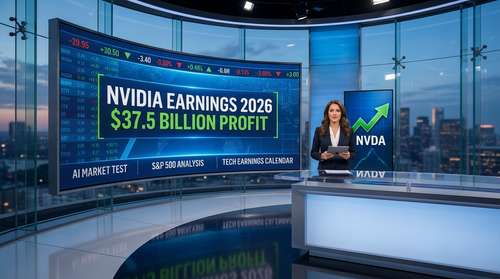
Wall Street is holding its breath. As U.S. stocks edge higher this Wednesday, investors are bracing for what is arguably the most consequential financial event of the year: the Nvidia earnings report 2026. With analysts projecting a staggering 70% profit surge to $37.5 billion, the stakes have never been higher for the AI chip giant. Today’s report isn't just about one company’s bottom line; it is a definitive litmus test for the entire artificial intelligence market, arriving amidst a week of volatility fueled by new tariff policies and the President’s State of the Union address.
The $37.5 Billion Profit Surge: Crunching the Numbers
The expectations for Nvidia’s fiscal fourth-quarter performance are nothing short of astronomical. Analysts from FactSet and other major firms forecast that Nvidia will report net income of approximately $37.5 billion, a massive 70% jump compared to the previous year. This Nvidia profit surge is underpinned by expected revenue of roughly $66.1 billion for the quarter alone—a figure that underscores the company’s absolute dominance in the semiconductor space.
While the headline profit number is the main attraction, savvy investors are looking deeper at the margins. With gross margins expected to hold steady near 75%, Nvidia continues to demonstrate unprecedented pricing power even as it scales production. The question on everyone's mind is whether this level of profitability is sustainable as the company transitions from its wildly successful Blackwell architecture to the next-generation platforms.
Beyond Blackwell: The Vera Rubin Era Begins
For the past year, the AI market trends today have been defined by the insatiable demand for Nvidia’s Blackwell chips. However, today's earnings call is expected to pivot the narrative toward the future. CEO Jensen Huang is widely anticipated to provide crucial updates on the upcoming "Vera Rubin" platform, which promises to reset the performance benchmarks for AI training and inference.
Supply chain constraints remain a key variable. With hyperscalers like Microsoft, Google, and Meta pouring an estimated $600 billion into capital expenditures in 2026, the demand for Nvidia’s hardware far outstrips supply. Investors will be listening intent for any guidance on production bottlenecks, particularly regarding the advanced packaging required for the Rubin chips. A confident outlook here could single-handedly reignite the tech rally.
Hyperscaler Capex: The Engine of Growth
The durability of the AI boom relies heavily on the spending habits of Big Tech. Recent reports suggest that major cloud providers are not slowing down; instead, they are doubling down on infrastructure to support agentic AI and physical AI applications. This unyielding investment cycle is the primary driver behind the bullish NVDA stock forecast, suggesting that the "ROI reckoning" many skeptics fear may still be years away.
Navigating Market Jitters: Tariffs and Politics
This earnings report does not exist in a vacuum. It lands during a particularly turbulent week for the tech earnings calendar, complicated by the macroeconomic backdrop. Following the President’s State of the Union address and the announcement of new tariff policies, the broader S&P 500 analysis has been mixed, with sectors reacting sharply to potential trade frictions.
Specifically, the AI investment strategy for many firms has been clouded by uncertainty over export controls and international trade dynamics. However, recent developments indicating that the U.S. may allow specific high-performance chip sales to China—albeit with revenue-sharing stipulations—could provide a surprising tailwind. If Nvidia confirms a stable path for its China revenue, it would remove a significant overhang that has plagued the stock for months.
What This Means for Your Portfolio
As the closing bell approaches, the implications of today's report extend far beyond Nvidia. A beat-and-raise quarter would likely send a ripple of relief through the entire tech sector, validating the trillions of dollars in market capitalization added over the last two years. Conversely, any sign of deceleration could trigger a sharp pullback, offering a buying opportunity for long-term believers in the AI thesis.
Ultimately, Nvidia remains the "main event" because it is the clearest window we have into the health of the digital economy. Whether you are a day trader or holding for the long haul, today's $37 billion verdict will set the tempo for the rest of 2026.