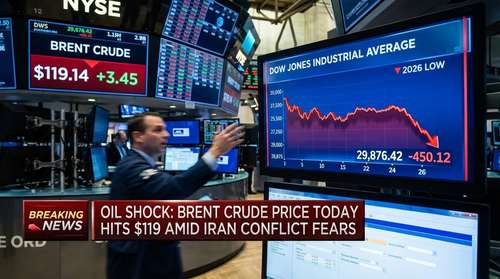
The global financial system is reeling as escalating conflict in the Middle East triggers massive disruptions across trading floors and commodities exchanges. The Brent crude price today briefly surged past $119 per barrel, unleashing a violent wave of energy market volatility. This sudden commodity spike fueled a severe stock market crash March 19 2026, pushing major equity indices into a tailspin and dragging the American benchmark down to a fresh Dow Jones 2026 low.
For investors and everyday consumers alike, the abrupt jump in global energy costs paints a grim economic picture. As military strikes systematically damage crucial infrastructure around the Persian Gulf, financial analysts warn that a sustained geopolitical crisis could paralyze international supply chains and halt economic growth.
Iran War Oil Impact: Strikes Rattle the Persian Gulf
The latest oil price hike news stems directly from an intensified theater of war. In direct retaliation to joint U.S. and Israeli air campaigns targeting a vital Iranian natural gas field, Tehran launched sweeping missile strikes against neighboring energy hubs. These aggressive attacks heavily damaged critical production sites, most notably striking one of the operational trains at the Pearl GTL plant in Qatar—widely recognized as the world's largest gas-to-liquids facility.
Global supply concerns have been exponentially magnified by the effective closure of the Strait of Hormuz, a maritime chokepoint responsible for approximately 20% of the world's daily oil transit. Early Thursday morning, international standard Brent crude soared to an astonishing $119 before stabilizing near $110 to $112.70. Benchmark U.S. crude mirrored this panic, climbing sharply above $96 per barrel in early trading hours.
Natural Gas and Tourism Take a Hit
The fallout extends far beyond crude oil. The European TTF benchmark for natural gas prices traded 17% higher on Thursday, effectively doubling over the past month as traders scramble to secure alternative energy sources. Meanwhile, the travel sector is facing its own crisis. Oxford Economics recently warned that nearly 28 million outbound trips from the Middle East are at risk this year, crippling an aviation industry already reeling from widespread airspace closures.
Wall Street Retreats: Reaching the Dow Jones 2026 Low
Equity markets absorbed the full force of the geopolitical shock. The resulting stock market crash March 19 2026 saw the Dow Jones Industrial Average plunge by more than 400 points at its lowest intra-day point. The index ultimately broke vital support levels, establishing a staggering Dow Jones 2026 low near 45,733.
The broader S&P 500 slipped by nearly 0.9%, pacing toward its fourth consecutive losing week, while the tech-heavy Nasdaq composite shed 1.2%. Companies heavily reliant on steady supply chains are bearing the absolute brunt of the sell-off. Airline stocks took a severe hit as thousands of international flights face cancellation due to the spiking cost of jet fuel.
The financial contagion was not limited to New York. Overseas trading floors suffered equally dramatic losses. Japan's Nikkei index dropped 3.4%, South Korea fell 2.7%, and Germany's DAX shed 2.6%. The synchronicity of these global declines underscores how heavily intertwined the modern economy remains with Persian Gulf energy exports.
Fearing a Global Inflation Surge 2026
Beyond the immediate valuation losses on Wall Street, the broader Iran war oil impact is casting a long, intimidating shadow over central bank policy. Only weeks ago, derivative traders confidently predicted multiple interest rate cuts from the Federal Reserve this year. That institutional optimism has completely evaporated.
Following its highly anticipated Wednesday meeting, the Fed opted to hold the benchmark interest rate steady. Federal Reserve Chair Jerome Powell delivered cautious commentary regarding the highly uncertain economic outlook, acknowledging that sustained energy price hikes pose severe risks to the American consumer. Derivative markets are now pricing in an 8% to 10% chance of a rate hike by year-end to combat a looming global inflation surge 2026.
The International Monetary Fund (IMF) echoed this dire sentiment. In a Thursday press briefing, IMF representatives issued a stark warning that prolonged crude supply disruptions could severely boost global inflation while simultaneously stalling worldwide economic growth. Economists are increasingly drawing sobering parallels to the 1970s energy crises, warning that prolonged disruption could usher in a painful period of stagflation.
Navigating Sustained Energy Market Volatility
Everyday consumers are already feeling the financial pinch at the pump, with gasoline prices in the United States rising rapidly since the conflict originally erupted in late February. The Trump administration has taken emergency steps to soothe panicked markets—including a temporary easing of sanctions on Russian oil to inject alternative supply into the global market. However, energy analysts widely view these measures as only providing short-term relief.
Israeli Prime Minister Benjamin Netanyahu stated Thursday that Iran's missile and drone arsenals are being massively degraded. Yet, physical damage to Arabian Peninsula energy infrastructure has already been done, and repairing these complex facilities will take significant time.
As long as the Strait of Hormuz remains heavily restricted and regional energy infrastructure sits in the geopolitical crosshairs, intense energy market volatility will persist. For everyday citizens and massive financial institutions alike, the days ahead require navigating an increasingly fragile and unpredictable economic landscape.