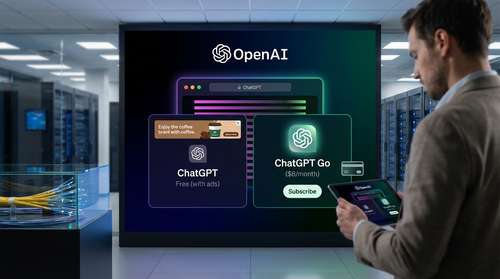
OpenAI has officially ended its strictly ad-free era, announcing the immediate rollout of advertisements for free-tier users and launching a new budget-friendly subscription dubbed ChatGPT Go. This strategic pivot, confirmed this week, marks a definitive shift from CEO Sam Altman’s previous description of advertising as a "last resort." As the company faces astronomical compute costs for its latest reasoning models, this move aims to monetize the massive user base of its generative AI tools while keeping access open to the public.
The New 'ChatGPT Go' Tier: What You Get for $8
The centerpiece of this announcement is the global launch of ChatGPT Go, a new subscription tier priced at $8 per month in the U.S. Designed to bridge the gap between the limited free version and the $20/month Plus plan, ChatGPT Go offers a middle ground for casual power users. However, there is a catch: unlike the Plus and Pro tiers, ChatGPT Go will include ads.
Subscribers to this new tier gain access to GPT-5.2 Instant, a model optimized for speed and efficiency. The plan boasts usage limits approximately 10 times higher than the free tier for messages, file uploads, and image generation. Additionally, it features an expanded context window, allowing the AI to remember more details about your preferences and ongoing projects over time. Despite the monthly fee, users on this plan will see sponsored messages, a decision that has sparked significant debate in the tech community.
Ads in ChatGPT: Privacy, Placement, and The 'Last Resort'
For the millions of users on the free tier, the experience is changing immediately. OpenAI has begun testing ads that appear at the bottom of chat responses. These advertisements are text-based and contextually relevant to the conversation. For instance, asking for a dinner recipe might trigger a sponsored suggestion for a grocery delivery service or a specific food brand.
OpenAI has emphasized a privacy-first approach to this rollout. The company stated that it will not share individual conversation data with advertisers. Furthermore, ads are strictly prohibited on sensitive topics such as health, politics, and mental wellness. Users also have the option to disable personalization settings, ensuring that ad targeting is based solely on the current session's context rather than long-term behavioral profiling.
The Pivot from "Unsettling" to Necessary
This development represents a stark reversal for OpenAI. In 2024, Sam Altman famously called the idea of ads in AI "uniquely unsettling" and a path he wished to avoid. The shift highlights the brutal economic reality of running cutting-edge AI. With the burn rate for compute infrastructure reportedly hitting $17 billion annually, the idealistic stance has given way to pragmatic survival.
The Cost of Intelligence: Why Ads Are Here Now
The driving force behind this decision is the sheer cost of generative AI costs. OpenAI’s newest models, particularly the reasoning-heavy iterations like GPT-5.2 Thinking and the o3 series, require exponentially more processing power than their predecessors. Industry analysts estimate that a single query on these advanced models can cost ten times more than a standard GPT-4 request.
To sustain this level of innovation without walling it off entirely behind high-ticket subscriptions, AI monetization through advertising became inevitable. The "Go" tier serves a dual purpose: it generates direct recurring revenue while offering a lower barrier to entry for users who find the $20 Plus plan too steep. Meanwhile, the ad-supported free model ensures that OpenAI can offset the operational costs of serving millions of non-paying users daily.
Industry Reaction and What's Next
The reaction to the ChatGPT free ads and the Go tier has been mixed. While financial analysts view it as a necessary maturation for a company eyeing a trillion-dollar valuation, user communities on platforms like Reddit have expressed concerns about "enshittification"—the gradual degradation of user experience in favor of profit. Comparisons are already being drawn to streaming services, where paying for a lower-tier subscription no longer guarantees an ad-free experience.
As the rollout continues, all eyes will be on how intrusive these ads become and whether the $8 price point for ChatGPT Go is attractive enough to convert free users, despite the presence of commercials. For now, the ad-free sanctuary of ChatGPT is officially reserved for those willing to pay the premium price.