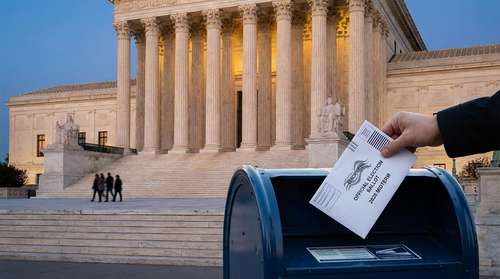
On Monday, March 23, 2026, the nation's highest court heard high-stakes oral arguments that could drastically reshape the future of American elections. The Supreme Court mail-in ballots case, formally known as Watson v. RNC, addresses a fundamental question: Should states be allowed to count mail-in votes that are postmarked by Election Day but arrive later? With the conservative supermajority signaling deep skepticism toward extended ballot receipt grace periods, the impending decision threatens to establish a strict, nationwide standard that could disenfranchise millions of voters just months ahead of the November elections.
The Legal Battle in Watson v. RNC
At the center of this pivotal piece of voting rights litigation is a contested Mississippi statute. The state law currently provides a five-business-day grace period, ensuring that any legally cast absentee ballot postmarked on or before Election Day will be counted if it arrives within that window. However, the Republican National Committee (RNC), alongside other conservative plaintiffs, launched a legal challenge arguing that this accommodation directly violates federal statutes dating back to 1845, which establish a single, uniform Tuesday in November as the designated day for federal elections.
After a federal district court initially upheld Mississippi's grace period, a panel from the U.S. Court of Appeals for the 5th Circuit reversed the decision. The appellate judges concluded that a valid vote must be both cast by the voter and physically received by election officials by the time the polls close. Mississippi Secretary of State Michael Watson appealed the ruling, sending the dispute directly to the Supreme Court.
Conservative Skepticism Over Mail-In Voting Deadlines
During the nearly two hours of oral arguments, the partisan divide on the bench was palpable. RNC attorney Paul Clement argued that extending mail-in voting deadlines beyond the established Tuesday is fundamentally wrong as a matter of "text, precedent, history and common sense". Several conservative justices appeared heavily inclined to agree.
Justice Brett Kavanaugh expressed concern over how delayed ballot tabulations impact public confidence. He suggested that when late-arriving ballots dramatically shift early election night leads, it can destabilize the perceived legitimacy of the results and open the door to accusations of a rigged process. Justice Neil Gorsuch took a more sarcastic tone, pressing Mississippi's legal team on whether a state would eventually accept "time-stamped videos" as proof a voter completed their ballot on time, regardless of when it was handed over to a postal carrier.
The Defense for State Election Authority
Conversely, the liberal wing of the court—Justices Sonia Sotomayor, Elena Kagan, and Ketanji Brown Jackson—defended the flexibility of state legislatures. They underscored the long-standing tradition of states managing their own election logistics. Mississippi Solicitor General Scott Stewart maintained that Congress merely intended for states to "make a final choice of officers by Election Day," not to outlaw standard administrative delays in mail delivery.
The Democratic National Committee (DNC) and several advocacy groups filed amicus briefs warning of the collateral damage. Beyond civilian absentee voters, a strict receipt mandate could devastate protections for military and overseas voters who face unpredictable international mail transit times. During the Civil War, states deliberately developed grace periods to ensure deployed soldiers were not disenfranchised by logistical hurdles—a historical precedent that Justice Sotomayor pointedly raised during Monday's session.
Establishing a Strict Election Day Receipt Deadline
If the Supreme Court sides with the RNC, the immediate consequence would be the implementation of a strict Election Day receipt deadline. This would completely invalidate the post-election grace periods currently utilized by 14 states and Washington, D.C. Furthermore, a sweeping conservative SCOTUS election ruling could potentially jeopardize the laws in 29 states and the District of Columbia that currently accept late-arriving ballots from deployed military personnel and overseas citizens.
The practical implications are staggering. During the 2024 general election, nearly one in three Americans—roughly 48 million voters—cast their ballots by mail. Eliminating the buffer for postal delays means that an individual could legally vote on the Monday before the election, but have their ballot thrown out simply because the U.S. Postal Service failed to deliver it by the following night.
Impact on 2026 Midterm Election Laws
A final decision is widely expected by late June or early July 2026. Handing down a ruling at the height of summer will leave local election administrators scrambling to overhaul 2026 Midterm election laws and procedures just weeks before federal absentee ballots must be mailed out in mid-September. If the court strips away these extensions, states from California to Nevada will have to reconfigure their entire ballot processing infrastructure overnight.
Election experts warn that executing such a drastic pivot will require massive, rapid voter education campaigns. "For those minority of states, red and blue, that allow for grace periods for mail ballots to be received, that would require some radical changes on their part and a huge burden of voter education," one election official highlighted in recent coverage. Voters accustomed to dropping their ballots in a mailbox on Election morning will need to be explicitly warned that doing so will likely result in their vote being discarded.
As the GOP, driven by former President Donald Trump's persistent attacks on mail voting, continues to aggressively litigate election mechanics, the upcoming ruling in Watson v. RNC may fundamentally redefine what it means to cast a timely vote in the United States. If the Supreme Court officially conflates the act of voting with the bureaucratic act of receiving, the American electoral system is poised for its most disruptive administrative shock in recent history.