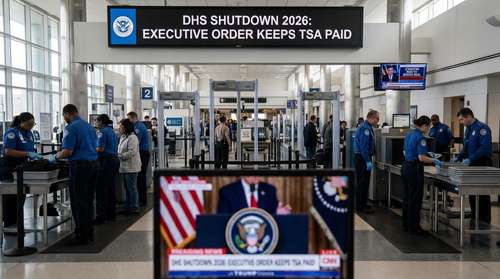
President Donald Trump has fundamentally shifted the ongoing political standoff in Washington, issuing a controversial Trump TSA executive order to ensure transportation security workers receive compensation. As the unprecedented 42-day partial closure of the Department of Homeland Security stretches on, thousands of federal workers were poised to miss yet another paycheck. With airport security lines stretching for hours and passenger frustrations boiling over, the administration's emergency maneuver bypasses a deadlocked Congress.
The sudden executive action arrived just hours after a late-night legislative collapse on Capitol Hill. While the Senate unanimously advanced a measure to restore agency funding, House conservatives vehemently blocked the path forward, leaving national infrastructure in limbo. The fallout from this clash has forced the White House to find creative financial solutions to keep American airspace operational.
Inside the Trump TSA Executive Order
Declaring that the American air travel system has reached its breaking point, the President formally bypassed traditional congressional appropriations to address the escalating crisis. The administration's directive mandates that the Department of Homeland Security immediately distribute backpay to more than 60,000 airport security agents who have been working without compensation since mid-February. Federal workers are now expected to see direct deposits arriving as early as Monday, March 30.
Administration officials confirmed that the temporary relief for government shutdown TSA pay will be sourced from unspent capital tied to the sweeping 2025 tax legislation, known as the One Big Beautiful Bill Act, rather than standard DHS coffers. This unusual financial maneuvering highlights the severity of the operational strain at major transit hubs. Earlier this week, the daily absentee rate for screening officers hit an alarming 11.83 percent nationwide. At highly trafficked hubs like John F. Kennedy International Airport, nearly 34 percent of scheduled officers missed their shifts, citing an inability to afford basic commuting costs or childcare.
A Stopgap for Aviation Security Funding
While the executive action guarantees immediate compensation for the screening workforce, industry experts warn that fundamental aviation security funding remains structurally compromised. The administration has deployed Immigration and Customs Enforcement personnel to assist at overwhelmed checkpoints, but former agency directors argue this is an unsustainable patch. Until Congress passes a comprehensive appropriations bill, long-term modernization projects and standard security logistics remain completely frozen.
Mike Johnson Rejects Senate Compromise
The President's intervention was immediately preceded by a fierce legislative rebellion in the lower chamber. Early Friday morning, the Senate passed a bipartisan spending package designed to end the DHS shutdown 2026. The Senate plan sought to fully fund the Transportation Security Administration, the Coast Guard, and the Federal Emergency Management Agency. However, it intentionally stripped funding for ICE and Customs and Border Protection following intense Democratic demands to restrict interior immigration enforcement operations.
House Speaker Mike Johnson aggressively shot down the Senate framework, describing the late-night legislative maneuver as an infuriating joke. The Mike Johnson DHS funding stance reflects conservative lawmakers refusing to accept a deal that omitted resources for border patrol agents and interior enforcement. The Speaker's hardline position underscores the deep partisan divide over immigration policy that originally triggered the February lapse in appropriations.
Instead of yielding to the upper chamber, Johnson announced plans to push a short-term continuing resolution that would maintain baseline funding for the entire department through May 22. Senate Democrats have already labeled the House GOP's counter-proposal as dead on arrival, virtually guaranteeing that the broader bureaucratic paralysis will persist into the spring.
The Truth Behind the Trump vs Johnson DHS Dynamics
Despite aggressive posturing on Capitol Hill, the notion of a hostile Trump vs Johnson DHS showdown appears to be a mischaracterization of the broader Republican strategy. Following his rejection of the Senate compromise, Speaker Johnson confirmed he had consulted directly with the Oval Office. According to congressional leadership, the President fully endorses the House Republicans' refusal to capitulate to Democratic demands regarding ICE funding reductions.
By executing unilateral authority to pay security screeners, the White House essentially removed the immediate political liability of collapsing airport operations. This calculated executive maneuver provides House Republicans with the political cover necessary to maintain their holdout for comprehensive border enforcement funding. With the immediate crisis of airport closures averted, conservative lawmakers face less public pressure to accept a fractured agency budget.
What This Means for Federal Employee Pay News
For the thousands of civil servants caught in the crossfire, the immediate outlook remains a mix of relief and anxiety. The latest federal employee pay news confirms that while screening personnel will see their overdue compensation, roughly 40,000 other DHS employees still face severe financial uncertainty. Union representatives are actively warning that essential personnel cannot endure an indefinite game of political brinkmanship.
The president of the American Federation of Government Employees, Everett B. Kelley, recently implored lawmakers to abandon the posturing, noting that families are struggling to pay for groceries and rent. While the TSA workforce secured a temporary lifeline, the remaining unfunded federal workers face the prospect of missing a third consecutive paycheck if the legislative impasse holds.
As the standoff enters its seventh week, travelers are advised to continue monitoring flight statuses and arriving early for domestic departures. While the immediate threat of a complete aviation standstill has been mitigated by the President's signature, the structural integrity of homeland security operations will remain fragile until lawmakers secure a permanent legislative resolution.