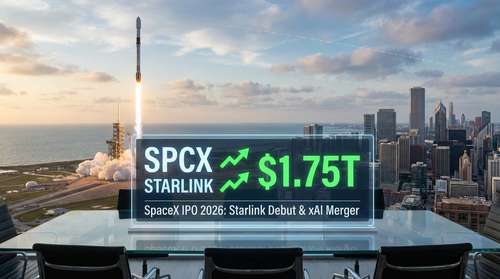
Financial markets are vibrating with anticipation as a long-awaited aerospace milestone appears to be on the horizon. According to confidential SEC filings reported in early April, the long-rumored SpaceX IPO 2026 is officially in motion. Targeting a June listing, this monumental event is poised to become the largest public offering in history, driven largely by the highly anticipated Starlink stock market debut. Wall Street analysts and retail investors alike are now bracing for an offering that could fundamentally reshape the technology and telecommunications sectors.
The $1.75 Trillion Question: Analyzing the Starlink Spin-Off Valuation
The numbers surrounding this public debut are staggering. Early reporting from April 1 indicated that SpaceX had filed confidentially for a public offering targeting a valuation of $1.75 trillion, with aims to raise between $50 billion and $80 billion in cash. If successful, the cash raise would easily eclipse the $29.4 billion record set by Saudi Aramco in 2019.
However, navigating the latest Elon Musk business news requires parsing reality from market exuberance. When Bloomberg reported on April 2 that the company might seek a valuation north of $2 trillion, Musk swiftly took to X to label the claim as "BS," dismissing the information as unreliable. Despite the CEO's pushback on the highest estimates, the baseline Starlink spin-off valuation remains astronomical. The aerospace behemoth was most recently valued internally at $1.25 trillion during recent transactions.
Rewriting the Upcoming IPO Calendar: The Starlink Juggernaut
Why are institutional investors so desperate to secure shares? The answer lies in orbit. Starlink has transformed from a speculative low-Earth orbit project into an absolute cash cow. The satellite internet provider surged past 10 million active subscribers by February 2026, commanding a dominant presence across 155 global markets.
For those interested in investing in satellite internet, the financials present a compelling case. Starlink achieved its first full-year profitability in 2024 with a reported $72.7 million net profit, fundamentally proving its high-margin subscription model. This momentum carried into 2025, where Starlink generated an estimated $12.3 billion in revenue, accounting for roughly 70% of SpaceX's total income. Analysts project that this segment alone could pull in up to $24 billion by the end of 2026. Furthermore, a strategic $17 billion acquisition of EchoStar's wireless licenses last fall has positioned the company to launch next-generation Direct-to-Cell satellites. This move transforms the service from a rural broadband solution into a direct competitor against traditional terrestrial mobile carriers.
The xAI Factor: Merging Space and Artificial Intelligence
A major catalyst pushing the valuation toward the $1.75 trillion mark is the recent internal consolidation of Musk's empire. In early 2026, SpaceX completed an all-stock merger with xAI, Musk's artificial intelligence venture, which PitchBook estimated to be worth roughly $250 billion. By bringing xAI under the SpaceX umbrella, the company secures a dedicated pipeline for space-based AI data centers and edge computing. The combined entity creates a unique financial synergy: Starlink generates the massive free cash flow required to purchase the vital Nvidia chips that power xAI's large language models.
Aerospace Stocks to Watch as the Market Reacts
While retail traders await the unsealing of the official S-1 prospectus, the ripple effects are already being felt across the broader market. You don't have to wait for the official listing to gain exposure; several secondary players are surging as the launch date approaches. Here are the primary aerospace stocks to watch right now:
- Alphabet (GOOGL): Google's parent company invested $900 million into SpaceX back in 2015 for roughly a 7% stake. Alphabet recently disclosed an $8 billion unrealized gain on its books, meaning the tech giant stands to profit massively from the impending liquidity event.
- EchoStar (SATS): Following its spectrum-for-equity deal with SpaceX last fall, EchoStar shares have rallied sharply. The company agreed to sell spectrum in return for up to $11 billion worth of SpaceX's Class A common stock, making it a proxy vehicle for pre-IPO investors.
- Rocket Lab (RKLB) and Planet Labs (PL): The rising tide is lifting smaller launch providers and Earth-observation companies. Both stocks traded higher following the April filing leaks, as institutional capital rotates back into the space economy.
The Competitive Landscape: Project Kuiper and Global Rivals
While the spotlight is firmly fixed on the SpaceX ecosystem, the broader sector is far from stagnant. Amazon's Project Kuiper recently began scaling its own low-Earth orbit constellation, launching dozens of satellites. However, competitors face a distinct disadvantage: they must purchase launch capacity from third parties. SpaceX's vertical integration—building the satellites and launching them internally on reusable Falcon 9s—provides a massive margin advantage that Wall Street is eager to premiumize.
Preparing Your Portfolio for the June Listing
As the upcoming IPO calendar centers entirely around this June target, market mechanics will undoubtedly shift. An offering of this magnitude is expected to siphon billions in institutional liquidity, forcing portfolio managers to rebalance their existing tech and telecommunications holdings to make room for the new equity. Retail investors should be prepared for significant price volatility during the initial days of trading, given the retail enthusiasm that typically follows Musk-led enterprises.
Until the formal roadshow begins and the confidential financials are unveiled, the financial world will be tracking launch schedules and subscriber metrics closely. Whether the final valuation lands near $1.25 trillion or pushes toward the contested records, the public market entry of the world's most valuable private company will undeniably redefine the investment landscape for years to come.