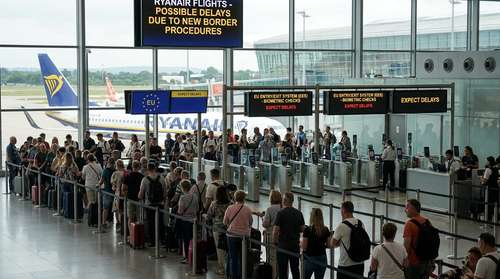
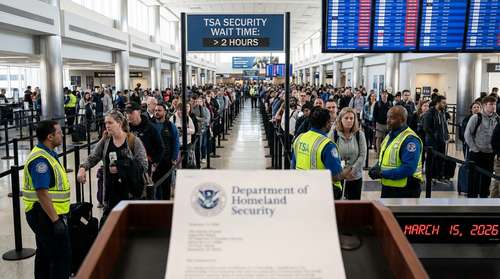
The United States is hurtling toward an unprecedented travel catastrophe as the US aviation system breaking point becomes a harsh reality this week. As millions of passengers endure record US airport security delays 2026 has brought, a new threat is looming over global travelers. Department of Homeland Security Secretary Markwayne Mullin has issued a dire DHS sanctuary city travel warning, suggesting the federal government may halt international processing at major airports in sanctuary jurisdictions. This political standoff collides with a grueling 47-day government funding lapse, exacerbating a devastating TSA shutdown pay crisis that has left roughly 50,000 security personnel working without reliable paychecks during the peak of spring break travel.
For passengers navigating terminals in New York, Chicago, and San Francisco, the friction is palpable. Travelers are already missing departures due to checkpoints stretched beyond capacity. If the DHS follows through on its latest threat, industry experts warn it could effectively paralyze some of the nation's most vital economic engines and trigger widespread spring break flight cancellations.
The Markwayne Mullin DHS Alert: Targeting Sanctuary Cities
The controversy ignited earlier this week when Secretary Mullin questioned whether sanctuary cities—which limit local law enforcement cooperation with federal immigration authorities—should retain the privilege of hosting U.S. Customs and Border Protection (CBP) operations. During a recent interview, Mullin argued that jurisdictions refusing to partner with ICE shouldn't expect federal customs agents to process incoming international passengers.
Questioning why non-compliant cities should process customs, Mullin signaled a potential international travel processing suspension at global hubs like John F. Kennedy International, Newark Liberty, and Chicago O'Hare.
Stripping CBP agents from these specific airports would bring overseas travel to a grinding halt in affected regions. Local leaders immediately condemned the proposal. Illinois Governor JB Pritzker characterized the strategy as an attack on the tourism industry and the broader American economy right before massive international events. Meanwhile, aviation analysts noted that rerouting millions of international passengers to non-sanctuary jurisdictions is logistically impossible, guaranteeing a historic bottleneck if the policy is enacted.
The 47-Day TSA Shutdown Pay Crisis
While the Markwayne Mullin DHS alert targets international arrivals, the domestic aviation sector is already buckling under the weight of the longest Homeland Security shutdown in modern history. The legislative funding lapse has forced over 50,000 Transportation Security Administration screeners to work without reliable compensation since mid-February.
The financial toll on this essential workforce has been staggering. Union representatives report that agents are facing severe financial hardship, with some sleeping in their vehicles because they cannot afford fuel for their daily commute. Consequently, hundreds of officers have simply resigned. The resulting staffing deficit has crippled security checkpoint operations. Nationwide, daily officer call-out rates have spiked to unprecedented levels, with some regional airports reporting massive absenteeism. To mitigate the bleeding, the government recently deployed non-furloughed ICE agents to airports like Baltimore/Washington International to assist with passenger clearance—a controversial stopgap measure that underscores the severity of the operational collapse.
Wait Times Soar Amid Spring Break Rush
The intersection of the TSA shutdown pay crisis and the surge of seasonal vacationers has created a perfect storm for travelers. At major transit points like Houston's George Bush Intercontinental Airport, the situation deteriorated rapidly last weekend. Propelled by massive crowds traveling for major events, including the NCAA Men's basketball tournament, checkpoint wait times exploded. In some instances, passengers reported waiting over four hours just to reach the physical screening areas, with lines wrapping outside terminal doors.
Airlines are scrambling to manage the fallout. United Airlines recently rolled out a new feature on its mobile app to provide real-time TSA wait estimates—a direct response to the operational unpredictability caused by the staffing deficit. Despite these digital band-aids, the sheer volume of travelers overwhelming understaffed checkpoints is forcing carriers to preemptively adjust their daily schedules. Industry watchdogs warn that unless staffing levels stabilize immediately, the ripple effects will lead to rolling spring break flight cancellations across the entire domestic network.
Nearing the US Aviation System Breaking Point
The dual threat of an international travel processing suspension and ongoing domestic security failures highlights an industry on the brink. While emergency funds were recently authorized in an attempt to provide back pay to TSA agents, the processing delays and low morale mean the workforce remains critically understaffed.
If the DHS proceeds with its threat to remove customs agents from sanctuary cities like Los Angeles and Boston, the localized security crisis will rapidly morph into a global logistics nightmare. Foreign airlines would be forced to divert flights, cargo supply chains would shatter, and domestic carriers would face catastrophic revenue losses.
For now, the US aviation system breaking point is visible in every crowded terminal and delayed departure board. Passengers booking travel through April are strongly advised to monitor airline updates, arrive at least three hours prior to domestic departures, and prepare for rapid changes regarding international itineraries as this political and economic standoff continues to unfold.